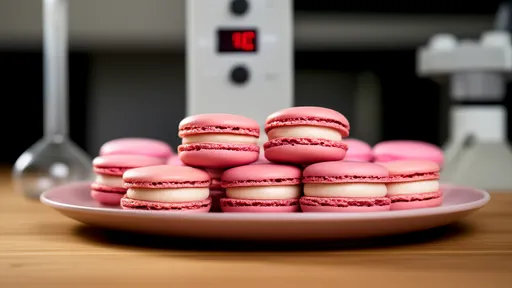
In the intricate world of patisserie, few creations demand as much precision and provoke as much anxiety as the French macaron. This delicate confection, a sandwich of two almond meringue shells cradling a flavorful filling, has become a global icon of refined baking. Yet, for every picture-perfect macaron boasting a flawless, frilly "foot" or "pied," colloquially and more elegantly known as the "skirt" or "jupes," there are countless batches that have fallen victim to cracked tops, hollow shells, or the most dreaded failure of all: a complete absence of this signature ruffled base. The journey to macaron mastery is fraught with variables, but seasoned pâtissiers and dedicated home bakers alike are increasingly pointing to one environmental factor as the ultimate arbiter of success or failure: ambient humidity.
The process begins long before the oven is even preheated. A macaron batter, or "macaronage," is a carefully balanced emulsion of finely ground almonds, powdered sugar, and a meringue made from whipped egg whites and granulated sugar. The key to achieving the batter's ideal consistency—often described as flowing like "lava" or molten magma—is the precise deflation of the meringue during the folding process. This stage is critical, but it is merely the prelude. The subsequent step, often overlooked by novices but revered by experts, is the "resting" or "drying" phase, famously known as "crusting" or "forming a skin." After the batter is piped onto baking sheets, the trays are left to sit at room temperature. This is not a passive waiting game; it is where the battle with humidity is truly joined.
The science behind this resting period is deceptively simple yet profoundly sensitive. The goal is to allow the surface of the piped macaron shells to dry out and form a thin, flexible membrane. This skin is the architectural keystone of the entire structure. When the macarons are placed in the oven, the internal moisture in the batter begins to heat up and expand, creating steam. This steam needs an escape route. The solidified top skin, now stronger than the wet batter beneath it, forces the expanding steam downward and outward through the bottom of the shell. This pressurized exit lifts the entire shell upward, peeling it away from the baking mat and creating that beautiful, airy, and crisp ruffled foot. It is a miniature culinary miracle of physics and chemistry.
This is where humidity asserts its decisive influence. Ambient humidity is a measure of the amount of water vapor present in the air. On a dry day, the air is thirsty; it readily absorbs moisture from any available source. The surface of the macaron shells loses water vapor quickly to the atmosphere, forming the necessary skin in a relatively short time, perhaps 20 to 30 minutes. The resulting skin is strong and resilient, perfectly equipped to direct the oven's steam and orchestrate a perfect rise and skirt formation.
Conversely, on a humid or rainy day, the air is already saturated with water vapor. It cannot accept more moisture. The evaporation process from the surface of the macaron shells grinds to a near halt. The shells may feel tacky to the touch for an hour or more, refusing to form a proper skin. A weak, under-formed skin is a recipe for disaster. In the oven, the expanding steam meets little resistance from the top. Instead of being channeled downward, it bursts through the weakest point—often the top of the shell—resulting in cracked, lopsided, or hollow macarons with no foot to speak of. The steam escapes chaotically, and the structure collapses. The macaron's potential is literally evaporated before it ever gets a chance to rise.
For professional kitchens, this variable is often mitigated by climate control. The patisserie becomes a laboratory, with dehumidifiers humming in the background during the summer months to ensure a consistent, low-humidity environment perfect for macaron production. This level of control is what allows high-end patisseries to produce hundreds of identical, perfect macarons day after day. Their reputation depends on this consistency, making the control of air moisture not just a technical detail, but a core business imperative.
The home baker, however, operates without such industrial aids. The kitchen is at the mercy of the weather. This is why a batch made on a crisp, sunny autumn afternoon can be flawless, while an attempt on a sticky, humid summer evening with the same recipe, same ingredients, and same technique can end in heartbreak. The baker is left bewildered, questioning their skill, unaware that the invisible water content in the air was the true culprit. This understanding is a rite of passage. It transforms the pursuit from blindly following a recipe to actively engaging with one's environment.
Armed with this knowledge, bakers have developed a suite of strategies to combat high humidity. Some extend the resting period dramatically, sometimes for two hours or more, patiently waiting for that elusive dry surface. Others seek out the driest room in the house, away from steamy kitchens or bathrooms. A common and effective trick is to turn on the air conditioning or a dehumidifier in the baking room for several hours beforehand. Some even resort to using a fan on a very low, cool setting to circulate air gently over the trays, though this must be done cautiously to avoid drying the tops too quickly and causing other issues. Checking the weather forecast has become as important as preheating the oven.
The macaron, therefore, is more than a cookie; it is a barometer. It is a dialogue between the baker and the atmosphere. Its success is a testament to the baker's ability to listen and adapt to these subtle environmental cues. The formation of the perfect foot, that delicate, frilly skirt, is the triumphant result of this dialogue. It is the moment when precise technique successfully negotiates with the whims of nature. It is not merely a sign of a well-executed recipe, but a badge of honor earned through understanding and overcoming the invisible challenge of humidity. In the end, that crisp shell and chewy interior represent a victory not just over ingredients, but over the very air itself.
By /Aug 20, 2025
By /Aug 20, 2025
By /Aug 20, 2025
By /Aug 20, 2025
By /Aug 20, 2025
By /Aug 20, 2025
By /Aug 20, 2025
By /Aug 20, 2025
By /Aug 20, 2025
By /Aug 20, 2025
By /Aug 20, 2025
By /Aug 20, 2025
By /Aug 20, 2025
By /Aug 20, 2025
By /Aug 20, 2025
By /Aug 20, 2025
By /Aug 20, 2025
By /Aug 20, 2025
By /Aug 20, 2025

By /Aug 20, 2025
