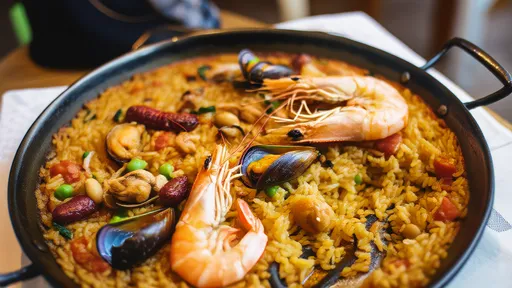
There is a moment in the cooking of a great paella that separates the merely good from the truly transcendent. It is not when the saffron blooms in the warm stock, painting the rice a glorious gold. It is not when the plump shrimp and mussels are arranged atop the pan like jewels. It is a quiet, almost alchemical transformation that happens at the very bottom of the pan, out of sight. It is the creation of socarrat.
To the uninitiated, socarrat might be mistaken for a culinary disaster—a layer of burnt, inedible rice. But for paella purists and Valencian grandmothers alike, it is the soul of the dish. This prized, caramelized crust is a textural marvel: a crackling, toffee-like sheet that offers a profound nutty depth and a satisfying crunch against the tender, fluffy grains above. Achieving it is the ultimate test of a paellero's skill, a delicate dance with fire that is as much about intuition as it is about technique. It is the pursuit of this perfect burn that fuels a lifelong passion for the dish.
The foundation of socarrat is laid long before the pan ever meets the fire. It begins with the choice of rice. Short-grain varieties like Bomba or Calasparra are non-negotiable. Their unique ability to absorb vast amounts of liquid—up to three times their volume—without becoming mushy is critical. They swell outward rather than breaking down, creating separate, distinct grains. More importantly, their sturdy structure allows them to withstand the intense, direct heat needed for socarrat formation without disintegrating into a starchy, scorched paste. This genetic predisposition for resilience is the first and most crucial building block.
Equally important is the pan itself. A traditional paella pan, or paellera, is wide, shallow, and made of thin, conductive carbon steel. This design is not arbitrary. The vast surface area allows for a thin, even layer of rice, ensuring maximum contact with the hot pan bottom. The thin metal responds instantly to changes in heat, giving the cook precise control. A thick-bottomed pot or Dutch oven would steam the rice, creating a creamy risotto-like consistency—the absolute antithesis of an authentic paella. The pan is an instrument, and its design is perfectly tuned for the symphony of socarrat.
The journey to socarrat is a patient one. The rice is added to the sofrito and toasted briefly before the hot stock is introduced. From this point, the rice is never stirred again. This is a cardinal rule. Stirring would agitate the grains at the bottom, releasing starch into the liquid and creating a creamy, homogenized layer, effectively preventing any chance of a clean, crisp crust from forming. The rice must be left to cook undisturbed, allowing the grains at the bottom to slowly caramelize and fuse together in a single, glorious sheet.
The true artistry, however, lies in the management of fire. The process requires a dynamic and dramatic shift in heat application, a technique often described as "listening to the pan." Initially, a robust, even heat is applied to bring the entire contents to a vigorous boil. This high heat is maintained until the liquid level drops just below the surface of the rice. This is the point of no return. The cook must now become a vigilant listener. The sound of the cooking paella will change from a loud, bubbling boil to a softer, sputtering crackle. This is the sound of the last of the surface liquid evaporating and the bottom layer of rice beginning to fry in the residual fats and oils from the stock and sofrito.
This crackle is the siren's call for the final, most aggressive burst of heat. For a period of sixty to ninety seconds, the flame is cranked to its maximum intensity. The goal is to superheat the pan's base, rapidly toasting the bottom layer of rice and creating the complex Maillard reaction—the same chemical process that browns a steak—without incinerating it. The entire kitchen fills with an intense, nutty aroma, a sure sign that the transformation is underway. This is a moment of extreme peril and potential glory. A few seconds too long, and the delicate socarrat will cross the fine line from caramelized to carbonized, becoming bitter and acrid.
Knowing precisely when to stop is a skill born of experience. There is no timer that can be set. The cook must rely on smell and, most famously, sound. As the socarrat forms, the crackling will become sharper, more pronounced. Some veteran cooks will gently tilt the pan, listening for the specific pitch of the sizzle. Others might carefully lift a corner with a spoon to visually check the color, looking for a deep, mahogany brown rather than stark black. The moment it is achieved, the pan must be immediately removed from the heat to stop the cooking process. The residual heat in the pan will continue to work, so timing the removal a hair early is often the mark of a true master.
Once off the fire, the paella must rest. This is not merely a suggestion for serving convenience; it is the final step in perfecting the socarrat. A rest of at least five, and ideally ten, minutes allows the dish to settle. The intense heat from the bottom dissipates evenly through the pan, gently finishing the cooking of the upper layers of rice without further threatening the precious crust below. It also allows the socarrat itself to set and harden slightly, making it easier to portion out with a spatula, ensuring each guest receives a piece of the crackling treasure.
Mastering socarrat is to understand that paella is not merely a recipe; it is a negotiation with elemental forces. It is about harnessing the aggressive power of fire to create something of sublime subtlety and complexity. It is a lesson in patience, restraint, and attentiveness. The reward for this effort is more than a delicious textural contrast. It is the taste of place, history, and tradition—a crackling, golden testament to the fact that sometimes, the most beautiful flavors are born on the very edge of ruin.
By /Aug 20, 2025
By /Aug 20, 2025
By /Aug 20, 2025
By /Aug 20, 2025

By /Aug 20, 2025
By /Aug 20, 2025
By /Aug 20, 2025
By /Aug 20, 2025
By /Aug 20, 2025
By /Aug 20, 2025
By /Aug 20, 2025
By /Aug 20, 2025
By /Aug 20, 2025
By /Aug 20, 2025
By /Aug 20, 2025
By /Aug 20, 2025
By /Aug 20, 2025
By /Aug 20, 2025
By /Aug 20, 2025

By /Aug 20, 2025
