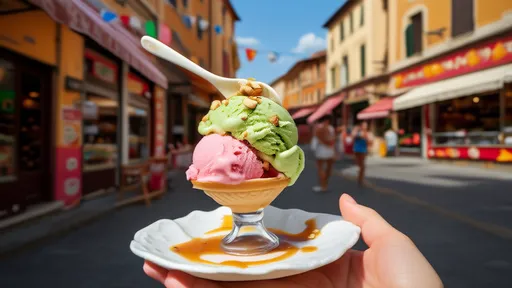
In the sun-drenched piazzas of Italy, where the air hums with the murmur of conversation and the clinking of espresso cups, there stands a counter that draws a perpetual crowd. It is not merely a vendor of cold treats; it is a temple to one of the country’s most cherished culinary arts: gelato. To the uninitiated, it might simply be the Italian word for ice cream. But to connoisseurs and artisans alike, the distinction is profound, rooted in a philosophy of purity, intensity, and a rigorous, almost sacred, adherence to rules that govern its very essence. The soul of authentic Italian gelato lies in two critical, and fiercely controlled, elements: its milk fat content and its air content, parameters that separate a true gelato from its imitators.
The journey of gelato begins not in a factory, but in a mindset—a commitment to artigianale, or artisanal, craftsmanship. This is not a product designed for long shelf-life or mass distribution across continents. It is crafted daily, in small batches, meant to be consumed within hours. This immediacy is the first clue to its superior quality. While industrial ice creams are built with stability and transport in mind, often relying on stabilizers, emulsifiers, and high-powered freezing, gelato is a delicate, ephemeral creation. Its character is directly dictated by the strict regulations and traditions that define the balance of its ingredients, with milk fat sitting at the heart of this delicate equilibrium.
Let us first demystify the role of fat. Fat is a primary carrier of flavor and is responsible for that luxurious, creamy mouthfeel we associate with frozen desserts. However, in the gelato universe, more is not always better. American-style ice creams are legally required to contain a minimum of 10% milk fat, but many premium and super-premium varieties soar far beyond this, reaching up to 16% or even 20%. This high fat content coats the palate, creating a rich and heavy sensation that, while delightful, can also dull the perception of other, more subtle flavors. It acts as a blanket, muting the very notes it is supposed to carry.
Authentic Italian gelato turns this principle on its head. Its milk fat content is typically mandated to be much lower, often hovering between 4% and 8%. This is not a compromise; it is a deliberate and calculated choice. The lower fat content allows the primary flavors—whether it be the profound bitterness of a dark cioccolato fondente, the vibrant acidity of fresh fragola (strawberry), or the aromatic punch of pistacchio di Bronte—to shine with unadulterated clarity. The palate is not overwhelmed by the weight of butterfat. Instead, it is greeted by an intense, immediate, and pure taste of the core ingredient. The creaminess is still present, but it serves as a elegant backdrop, a silky texture that enhances rather than obscures the star of the show. This meticulous balancing act is the first pillar of gelato’s superiority.
If milk fat content defines gelato’s flavor profile, then air content is the master of its texture and density. The process of churning any frozen dessert incorporates air, a factor measured by a term called "overrun." This refers to the percentage increase in volume from the original base mix due to the air whipped into it. For most commercial ice creams, overrun is a tool for profit. It is not uncommon for economical ice creams to have an overrun of 100% or even higher, meaning the volume of air equals or exceeds the volume of the original ingredients. You are, quite literally, paying for air. The result is a product that is light, fluffy, and melts quickly into a frothy liquid, but often lacks substance and a satisfying, dense chew.
Gelato, in stark contrast, is churned at a much slower speed. This incorporates significantly less air, typically resulting in an overrun of only 20% to 35%. The implications of this are profound. With less air taking up space, the mixture of milk, cream, sugars, and flavorings is packed more tightly together. This yields a denser, heavier product that feels substantial on the spoon and melts slowly, luxuriously, on the tongue. This density is directly responsible for gelato’s signature elastic, almost stretchy texture—a quality Italians refer to as body. It is a more satisfying and intense sensory experience. When you take a scoop of gelato, you are getting far more of the actual product you came for, not a aerated imitation. The control of air is the second, equally crucial, pillar supporting the art of true gelato.
The synergy between low fat and low air content is where the magic truly happens. The lower fat content prevents the flavors from being muted, while the minimal air content ensures those potent flavors are delivered in a concentrated, dense form. This creates a feedback loop of intensity. A bite of hazelnut gelato doesn’t just taste like hazelnut; it feels like consuming the essence of the nut itself, in a smooth, cool, and profoundly satisfying paste. This is why a small cup of genuine gelato can feel more fulfilling and decadent than a much larger portion of airy, fatty ice cream. It is a lesson in quality over quantity, in intensity over volume.
This devotion to such strict parameters does not come without its challenges for the gelatiere, the gelato maker. With less fat to provide structure and less air to insulate it, artisanal gelato is inherently unstable. It cannot withstand fluctuating temperatures. It begins to degrade in texture and separate if not kept at a perfect, consistent serving temperature of about -12°C to -14°C (10°F to 6°F), which is slightly warmer than the hard-frozen storage of ice cream. This is why the gleaming stainless steel counters in gelaterias are not merely for display; they are precision instruments, maintaining the fragile ecosystem of the gelato within. This fragility is its badge of honor—proof that it is a fresh, natural, and unconpromised product.
Ultimately, the story of Italian gelato is a story of restraint and precision. It is a culinary tradition that understands that true luxury is not about excess, but about harmony. It is about having the discipline to hold back, to use just enough cream to provide silkiness but not so much that it overpowers, to incorporate just enough air to achieve smoothness but not so much that it cheats the customer. The next time you find yourself before a gleaming array of pastel-colored vaschette in Italy, look for the signs of authenticity: the muted, natural colors, the dense appearance that sits flat in its container, and the label produzione propria (our own production). In that scoop, you will taste the direct result of centuries of refinement—a perfect, dense, intensely flavorful testament to the power of严格控制, of严格控制 milk fat and air.
By /Aug 20, 2025

By /Aug 20, 2025
By /Aug 20, 2025
By /Aug 20, 2025

By /Aug 20, 2025

By /Aug 20, 2025
By /Aug 20, 2025

By /Aug 20, 2025
By /Aug 20, 2025
By /Aug 20, 2025
By /Aug 20, 2025
By /Aug 20, 2025
By /Aug 20, 2025
By /Aug 20, 2025
By /Aug 20, 2025
By /Aug 20, 2025
By /Aug 20, 2025
By /Aug 20, 2025
By /Aug 20, 2025

By /Aug 20, 2025
